Boise sits at an elevation of 2,730 feet along the Boise River, where the valley floor consists of alluvial sands and gravels interbedded with clayey silts. This stratigraphy, deposited by ancient Lake Idaho, creates sharp impedance contrasts that can amplify seismic waves during an earthquake. An HVSR microtremor survey in Boise Idaho captures ambient vibrations from wind and traffic to calculate the fundamental resonance frequency of the soil column. The method, developed by Nakamura in 1989, requires no boreholes or artificial sources — just a three-component seismometer left recording for 30 to 60 minutes. The resulting H/V spectral ratio curve tells engineers exactly where the site period falls, which is critical when designing to avoid resonance with a building's natural frequency. For deeper characterization, this passive survey is often paired with an active MASW profile to verify shear-wave velocity layering.
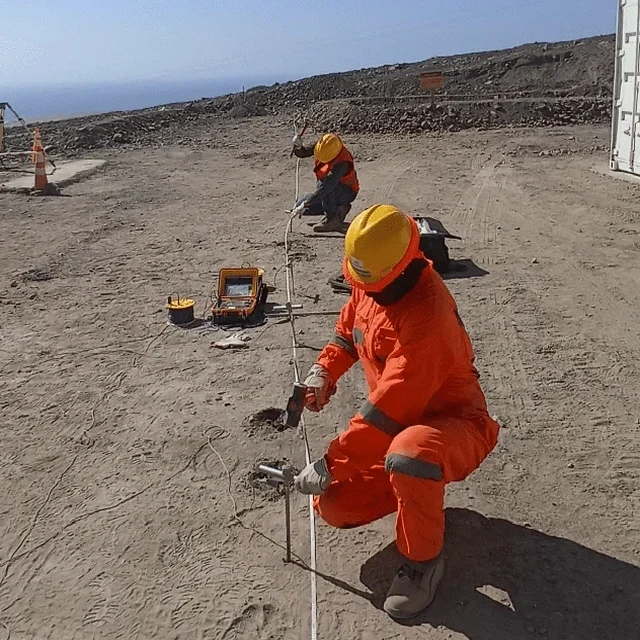
An HVSR survey reveals the fundamental frequency of the soil column, allowing engineers to check for building-soil resonance before foundation design is finalized.
Method and coverage
Regional considerations
The primary seismic risk in Boise Idaho comes from the Central Idaho Seismic Zone and the nearby Lost River Fault, which produced the 1983 Borah Peak earthquake (Mw 6.9). Alluvial basins like the Boise Valley can amplify long-period ground motions by a factor of 2 to 4 relative to bedrock sites. An HVSR microtremor survey in Boise Idaho identifies whether the site period falls in the 0.3–0.8 second range typical of 3- to 8-story buildings — a common height for Boise's newer apartment blocks and medical offices. If the site period matches the building's fundamental period, resonance can double the spectral acceleration, pushing demands beyond code-minimum design. The survey also detects lateral variations in sediment thickness, which is useful when a single parcel straddles both the river terrace and the floodplain.
Standards that apply
SESAME 2004 (Site Effects Assessment Using Ambient Excitations), IBC 2021 Section 1613 (Seismic Ground Motion Values), ASCE 7-22 Chapter 20 (Site Classification for Seismic Design), NEHRP Recommended Seismic Provisions (FEMA P-1050)
Related services
Single-Station HVSR Survey
A rapid screening using one seismometer deployed at up to 10 stations across the site. Ideal for small parcels or preliminary zoning. Delivers f0, H/V amplitude, and site period within 48 hours of field completion.
Array-Based HVSR with MASW Integration
Combines passive HVSR measurements with an active MASW line along the same transect. The joint inversion yields a 1D shear-wave velocity profile to 30–50 meters depth, directly applicable to ASCE 7 site class determination.
Seismic Microzonation Study
For large developments or subdivisions in Boise's expanding fringe areas. A grid of 20+ HVSR stations maps the spatial variation of site period and amplification factor across the property, supporting optimized foundation placement.
Typical parameters
Top questions
How does an HVSR microtremor survey differ from a traditional MASW survey?
HVSR uses ambient vibrations (microtremors) as the signal source and requires no artificial energy — no sledgehammer, weight drop, or vibrator. It measures the H/V spectral ratio to find the fundamental resonance frequency of the soil column. MASW, by contrast, uses active surface waves (Rayleigh waves) to build a shear-wave velocity profile. The two methods are complementary: HVSR identifies the site period, while MASW provides the velocity-depth model needed to estimate sediment thickness and site class.
What is the typical cost range for an HVSR survey in Boise Idaho?
For a standard single-station survey covering 8 to 12 measurement points, the cost ranges between US$1,680 and US$2,200, including field deployment, data processing, and a written report with H/V curves and site period interpretation. Larger arrays or combined MASW+HVSR projects will increase the scope and price accordingly.
Can HVSR replace a standard geotechnical boring for seismic site classification?
No — HVSR alone cannot replace a boring because it does not provide soil classification, density, or strength parameters. However, when combined with one or two confirmation borings or a MASW profile, HVSR significantly reduces the number of boreholes needed. It fills the gaps between borings by mapping lateral continuity of the soil column's dynamic response.
How long does an HVSR microtremor survey take from field work to final report?
Field deployment for a typical 10-station survey in Boise takes one day. Data processing and interpretation follow within three to five business days. The final report includes each station's H/V curve, the fundamental frequency f0, an interpretation of the site period relative to building resonance, and a table of H/V peak amplitude and stability indicators.