Boise sits at an elevation of about 2,700 feet, where the Boise River has carved a valley filled with alluvial sands, gravels, and occasional clay lenses. This mix of sedimentary layers creates significant variability in soil behavior across short distances. For any foundation or earthwork project here, understanding the shear strength and stress-strain response of those soils is non-negotiable. The triaxial test delivers that data, simulating in-situ confining pressures to give engineers a reliable failure envelope. Whether we are looking at a shallow foundation in the North End or a deep excavation near the river corridor, the parameters from this test feed directly into slope stability calculations and bearing capacity analysis. Pairing the triaxial test with a stability analysis for excavated slopes helps us anticipate failure modes before they appear in the field.
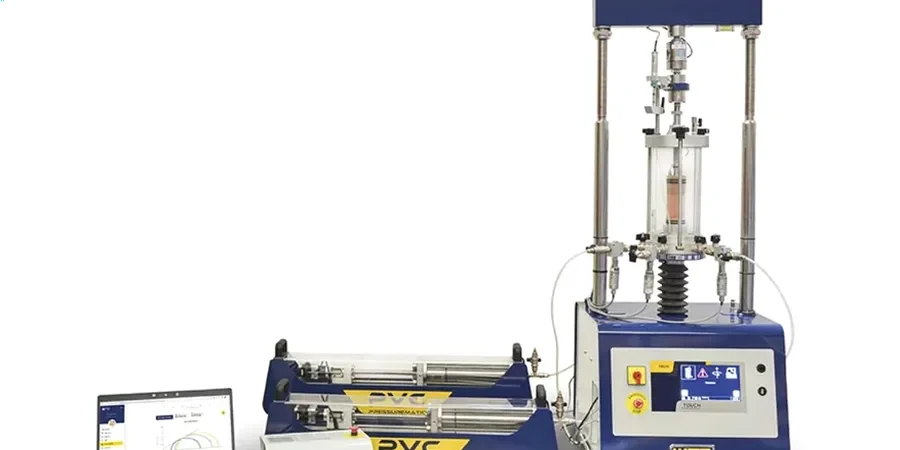
A consolidated-undrained triaxial test with pore pressure measurement reveals how Boise's silty sands behave under rapid loading, directly informing safe construction sequencing.
Method and coverage
Regional considerations
The triaxial test itself is performed using a computer-controlled loading frame and a triaxial cell capable of applying independent confining and deviator stresses. In Boise, the primary risk is not with the equipment but with sample disturbance. Soils from the alluvial terraces often contain gravel or coarse sand that can tear the rubber membrane during assembly, leading to premature failure and invalid results. To avoid this, we carefully hand-trim specimens and use thicker membranes when the soil contains angular particles. Another common issue is incomplete saturation in CU tests, which can mask the true pore pressure response. We monitor the B-value throughout back-pressure saturation and only proceed when it reaches at least 0.95, per ASTM guidelines.
Standards that apply
ASTM D2850-15 (UU Triaxial), ASTM D4767-11 (CU Triaxial with Pore Pressure), ASTM D7181-20 (CD Triaxial), ASTM D2487-17 (Unified Soil Classification)
Related services
Unconsolidated-Undrained (UU) Triaxial
Rapid test on undisturbed samples to measure undrained shear strength. Ideal for short-term stability checks in clayey soils common along the Boise River corridor.
Consolidated-Undrained (CU) Triaxial with Pore Pressure
Measures effective stress parameters and pore pressure development. Recommended for slope stability and foundation design in Boise's silty sand deposits.
Consolidated-Drained (CD) Triaxial
Slow, drained test for long-term strength parameters. Used in embankment and retaining wall design where full drainage is expected over time.
Multi-Stage Triaxial Test
Single specimen tested at three confining pressures. Cost-effective for projects with limited sample availability, typical of small residential developments in Boise.
This service complements our laboratory testing work for a complete project analysis.
Typical parameters
Top questions
What is the difference between UU, CU, and CD triaxial tests?
UU (unconsolidated-undrained) applies load without allowing drainage or consolidation, giving undrained strength for immediate conditions. CU (consolidated-undrained) consolidates the sample under confining pressure before shearing, measuring pore pressure during loading. CD (consolidated-drained) allows full drainage throughout shearing, providing effective stress parameters for long-term analysis.
How much does a triaxial test cost in Boise?
Pricing typically falls between US$1,780 and US$2,800 per test, depending on the test type (UU, CU, CD), number of confining stages, and whether pore pressure measurement is required. Volume discounts apply for multiple specimens.
What soil types in Boise require triaxial testing?
Silty sands and low-plasticity clays from the Boise River floodplain are the most common candidates. These soils exhibit strain-softening behavior and significant pore pressure build-up under load, making triaxial testing essential for reliable strength parameters.
How long does it take to get results?
A UU test can be completed within 2 to 3 business days. CU tests require additional time for saturation and consolidation, typically 5 to 7 business days. CD tests are the slowest, often taking 2 to 3 weeks due to the slow strain rate required for full drainage.