The Treasure Valley sits on a thick sequence of Quaternary alluvial deposits from the Boise River, with interbedded sands, silts, and gravels reaching depths over 100 meters. These layers vary widely in compaction and drainage, making the laboratory CBR test essential for pavement design. We soak specimens for 96 hours per ASTM D1883 and measure penetration resistance at 0.1-inch increments, correlating results directly to the structural number for flexible pavements. For soil-cement stabilized bases common in local subdivisions, we complement the CBR with a Proctor compaction test to verify moisture-density targets before molding specimens.
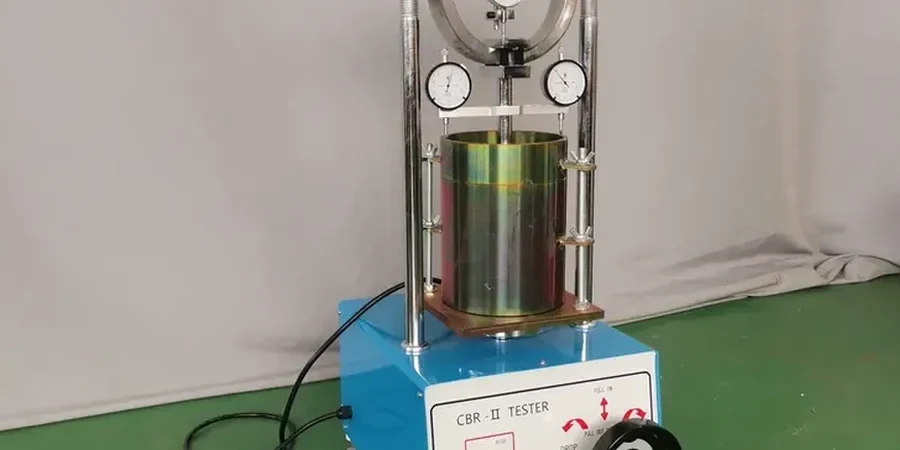
Soaked CBR below 3 on a Boise River terrace fill means the subgrade will need 18 inches of select granular borrow to carry light commercial traffic.
Method and coverage
Regional considerations
A 10-inch concrete slab on grade for a warehouse near I-84 and Cole Road was designed using a CBR of 8 from a nearby borrow source. The actual subgrade, a silty clay with plastic fines, tested at CBR 3 after soaking. Within two winters, the slab corner cracked under forklift loads. That mismatch is avoidable when the laboratory CBR test is run on the exact material at the in-situ density and moisture, not on an assumed value from a geotechnical report from the next block.
Standards that apply
ASTM D1883-21 (Standard Test Method for California Bearing Ratio of Laboratory-Compacted Soils), AASHTO T 193-13 (The California Bearing Ratio), FHWA NHI-05-037 (Pavement Design Manual, Chapter 4 – Subgrade Evaluation)
Related services
Standard Soaked CBR (ASTM D1883)
Four-day soaking with swell monitoring, penetration test at two energy levels, and report with CBR at 0.1 and 0.2 inches. Used for flexible pavement design on residential streets and commercial parking lots across the Treasure Valley.
Unsoaked CBR for Rapid Assessment
Same compaction and penetration procedure without the 96-hour soak. Delivers results in 24 hours, suitable for temporary haul roads or construction platforms where long-term saturation is not expected.
CBR on Stabilized Soils
Specimens mixed with cement, lime, or fly ash at design percentages, cured 7 days, then soaked and tested. Common for base course optimization on Ada County Highway District projects requiring minimum soaked CBR of 40.
Typical parameters
Top questions
How many pounds of soil do I need to bring for a laboratory CBR test?
For a six-inch mold with compaction at three energy levels, we need about 60 pounds of material passing the 3/4-inch sieve. If you also want a Proctor compaction test on the same sample, add another 40 pounds.
What is the difference between soaked and unsoaked CBR?
The soaked CBR simulates worst-case subgrade moisture after spring thaw or heavy rain. The specimen is submerged for 96 hours, and the swell is recorded before penetration. Unsoaked CBR skips that step and gives a higher value, used only when the pavement will never see prolonged moisture.
How much does a laboratory CBR test cost in Boise?
The typical cost for a standard soaked CBR test with one compaction level ranges between US$120 and US$220. Multi-energy curves or tests on stabilized materials may increase the price by 30 to 50 percent.